

Entrepreneurship Level – Transformation of Small Entrepreneurs Into Big Entrepreneurs. There are 5 levels of Entrepreneur or Company. I am based on more than 20 years of business experience. This division is based on the governance and operation of the business, as well as dependence on the founder or owner of the company, not solely the size / turnover, although revenue and profit also largely determine how the company can be managed.
To move between levels requires a major transformation. It can be gradual and take a long time. If I often call it moving the sky, it is no longer just a scale-up(growing), because of significant differences in form and governance.
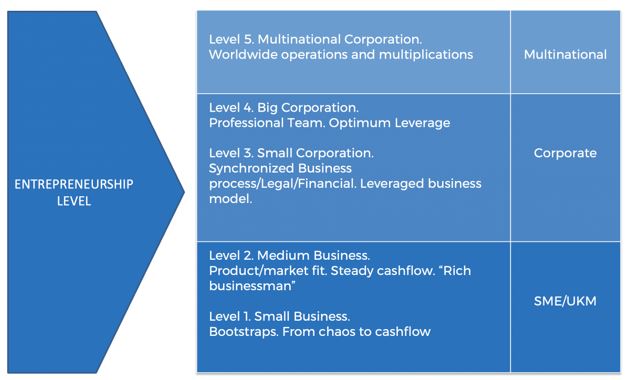
enterpreuneurship level
1. Entrepreneur Level 1: Bootstrap. Micro/Small/Beginner Entrepreneurs
Level 1 entrepreneurs are budding entrepreneurs under 1 billion per year, or it could be more. It could be that he started his own business, with a partner or subordinate.
The focus of Business Level 1 is to survive, grow, and find the most suitable business model. It could be that a business has been running for a long time but remains at this level, until it closes. This is the level where the business is very dependent on the personality and strength of the entrepreneur himself, both financially and operationally, even depending on the personal life of the entrepreneur.
2. Level 2 Entrepreneur: Steady Business. Small/Medium Entrepreneurs
Is an entrepreneur who has a stable business, usually has been running for more than 5 years in the same field, has found his own niche market, as well as has an operational system and can delegate a lot of operational work. Usually they already have a turnover above 10 billion per year.
There are also many wealthy Level 2 Entrepreneurs, having run their businesses for many years. The owner is wealthy, but his company (or some of his companies) is still a small company.
Most entrepreneurs in Indonesia are at Level 1 or 2, or commonly called MSMEs, and remain at this level until the end of their lives, or the end of their company’s life. Often the age of a company follows the age of its founder/owner, as well as its strength.
If the purpose of doing business is to achieve financial freedom, reaching Level 2 can be enough, even more than enough, because some owners at this point are already very wealthy.
The owner of a business at this level can do a lot with the wealth he has, can do charity and carry out social missions, or fulfill his hobbies, can save, or invest by creating a second and third business.
3. Level 3 Entrepreneurs/Companies: Leveraged Company. Companies With Systems and Organizations Capable of Duplicating Business
This is a transition level. That is the transition from an entrepreneur to a company. The point where the entrepreneur, when the business is stable and large enough, forms a system and organization that is standard and can be run by the management team, and the system can be duplicated for the benefit of company expansion.
There is no standard turnover limit anymore about when to start. But generally it takes business stability for 10 years with a turnover of 50-100 billion, depending on the type of business.
With the system, companies with a management team can run on their own and it is easier to duplicate their business, even though the figure of the entrepreneur is still quite dominant. Without system readiness, often business duplication simply ends with duplication of problems.
Not all types of businesses can go up to Level 3, some can go up but have to change their business model, or be merged/acquired with other companies to create a better business model.
The move from Level 2 to Level 3 requires the entrepreneur’s great commitment to leave the comfort (complacency), due to bureaucracy, division of power, control, and even division of ownership.
The credibility of the company at this level is also much better, so that the company can leverage by doubling its value, either through loans that are much greater than the value of its assets, or getting investors, both private and public investors.
Companies that are newly established by other large companies, usually go directly to this level. Likewise, startups that are just starting out and immediately get large funding. Startups like this usually pass Levels 1 and 2 briefly. Why? Because they already have systems and organizations that can be duplicated.
4. Level 4 Company: Corporation. Large National Scale Enterprises.
Level 4 companies are corporations that are no longer dependent on the owner, and can be fully run by professionals, ranging from the highest level to the bottom, with systems and organizations (Level 3) that have been tested and can be duplicated properly. Usually it can be done when the company’s turnover is above 500 billion.
The company’s expansion can also go well, and even the expansion is enough for middle-level management. Another characteristic is that the organization in the company has been multi-layered so that the soldering and regeneration of its staff can run well internally and easily find talents / professionals because the career path and development of the organization are promising.
Companies of this level are usually more well-known and “bigger” than their founders, and are usually already owned not only by 1 party/family. Often it is already a public company, although there are still controlling shareholders.
Anyway, Level 4 companies can live longer than their founders, even usually aged for decades. Once when the founder or one of the owners dies, the company can continue to run well. The owner’s shares can be inherited without having the heir have self-employed skills or manage the business. Selling a company is also easier because the buyers can be from all over the world.
5. Level 5 Company: Global Corporation. Global Giants
Level 5 companies are already fully corporatized companies, large publicly sized companies, with a turnover of over 5 Trillion, which no longer have a majority shareholder, and are already operating globally in at least 1/3 of the world (50 countries) and have been running for decades. It’s the kind of company that’s too big to fail.
Companies like Unilever or P&G for example. The owner is no longer known to us and is no longer involved in determining the vision and strategy, let alone the company’s operations. There are only a few companies like this in the world, and it can be said that there are no companies in Indonesia.
What level is your company?
Entrepreneurship Level – Transforming Small Entrepreneurs into Big Entrepreneurs
By: Ahmad Sadat
Source :
https://amsadat.blog/2021/02/03/pengusaha-kecil-pengusaha-besar/